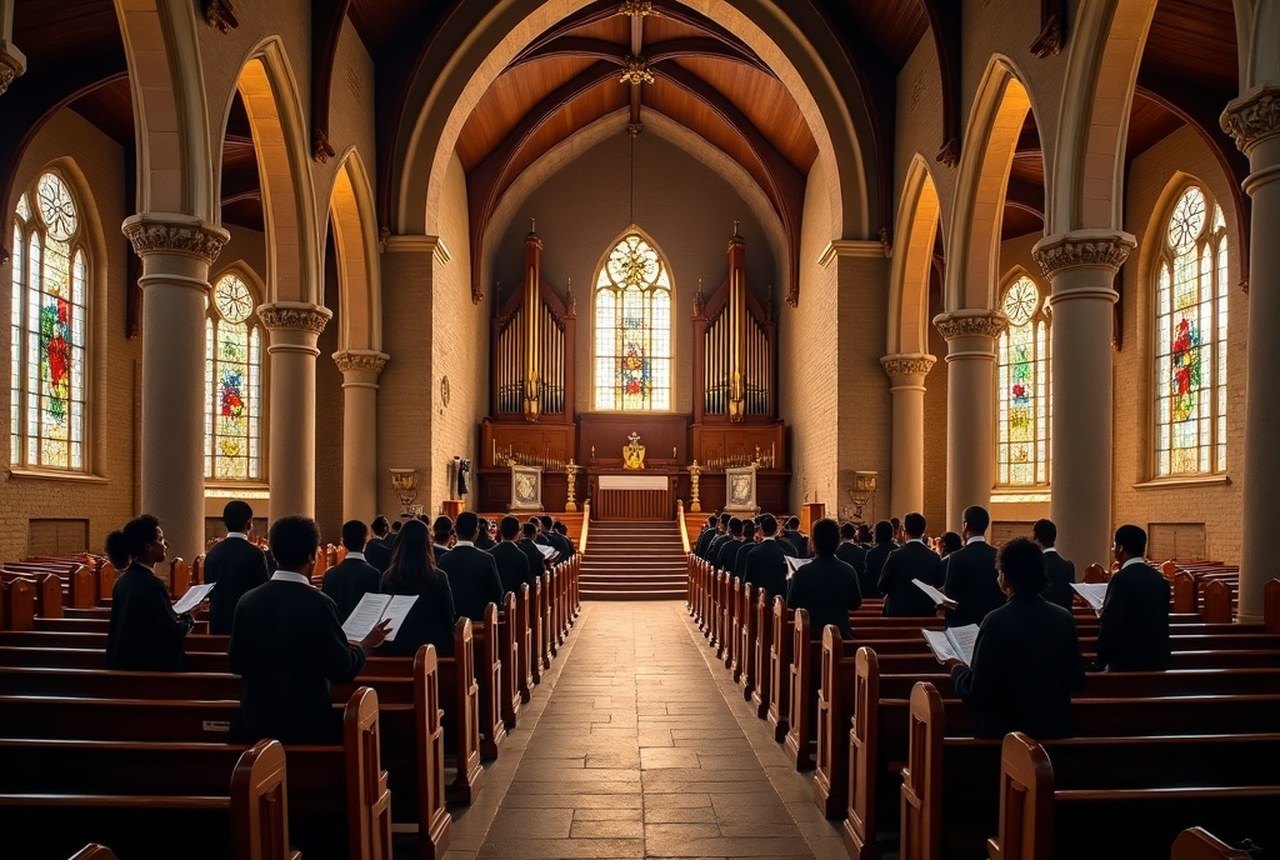
When the Great Migration arrived by rail at Chicago's Illinois Central terminal, Olivet Baptist was often the first institution to meet it.
At a glance
- Founded
- 1850
- Tradition
- Baptist
- Place
- Dr. M.L. King Jr. Drive, Chicago
- Note
- Model institutional church of the Migration era
IA Congregation That Caught a Generation
Founded in 1850 and reorganized after the Civil War, Olivet Baptist Church had already established itself as one of Chicago's leading Black congregations before the twentieth century began. But it was the Great Migration — the vast movement of African Americans out of the Jim Crow South that accelerated sharply after 1915 — that transformed Olivet into something without precedent in American religious life.
As trains unloaded thousands of newcomers onto Chicago's South Side, Olivet's leadership understood the moment. Under the pastorate of Lacey Kirk Williams, who served from 1916, the congregation built what amounted to a city within a church. Employment bureaus, housing referral services, a nurse's station, kindergartens, a savings program — the range of social ministries Olivet offered reflected the full weight of what newly arrived families needed. By the early 1920s, membership had swelled to somewhere near ten thousand, making it one of the largest Baptist congregations in the United States at that time.
The building itself announced that scale. Olivet occupied a massive former white congregation's structure on South Parkway — now Dr. Martin Luther King Jr. Drive — a building whose capacity matched the ambition of the community it served. The sanctuary became a stage for the tradition's fullest expression: the commanding Black sermonic art, call-and-response between preacher and congregation, and a musical culture that evolved directly alongside the birth of gospel music in Chicago's own storefront churches and sanctuaries.
Olivet's role extended well beyond its walls. It functioned as what historians of the Black church describe as the model institutional church of the migration era — part worship house, part civic infrastructure, part welcome center for a displaced and determined people. That role of the church as community anchor and social institution has deep roots across the tradition, but Chicago's scale gave it an unmatched intensity. The ethic of communal uplift that Olivet embodied would shape Black Chicago's civic culture for decades.
The congregation's influence also radiated outward through its networks. Ministers trained and nurtured within Olivet's orbit spread across the city and the denomination, carrying with them a model of engaged, institutional ministry.
Olivet Baptist remains an active congregation on Chicago's South Side, still formally part of its long Baptist heritage. For the heritage traveller, it stands as essential ground — a place where the arc of the Great Migration, the genius of Black institutional life, and the sheer vitality of the Black church tradition all converged in one address.