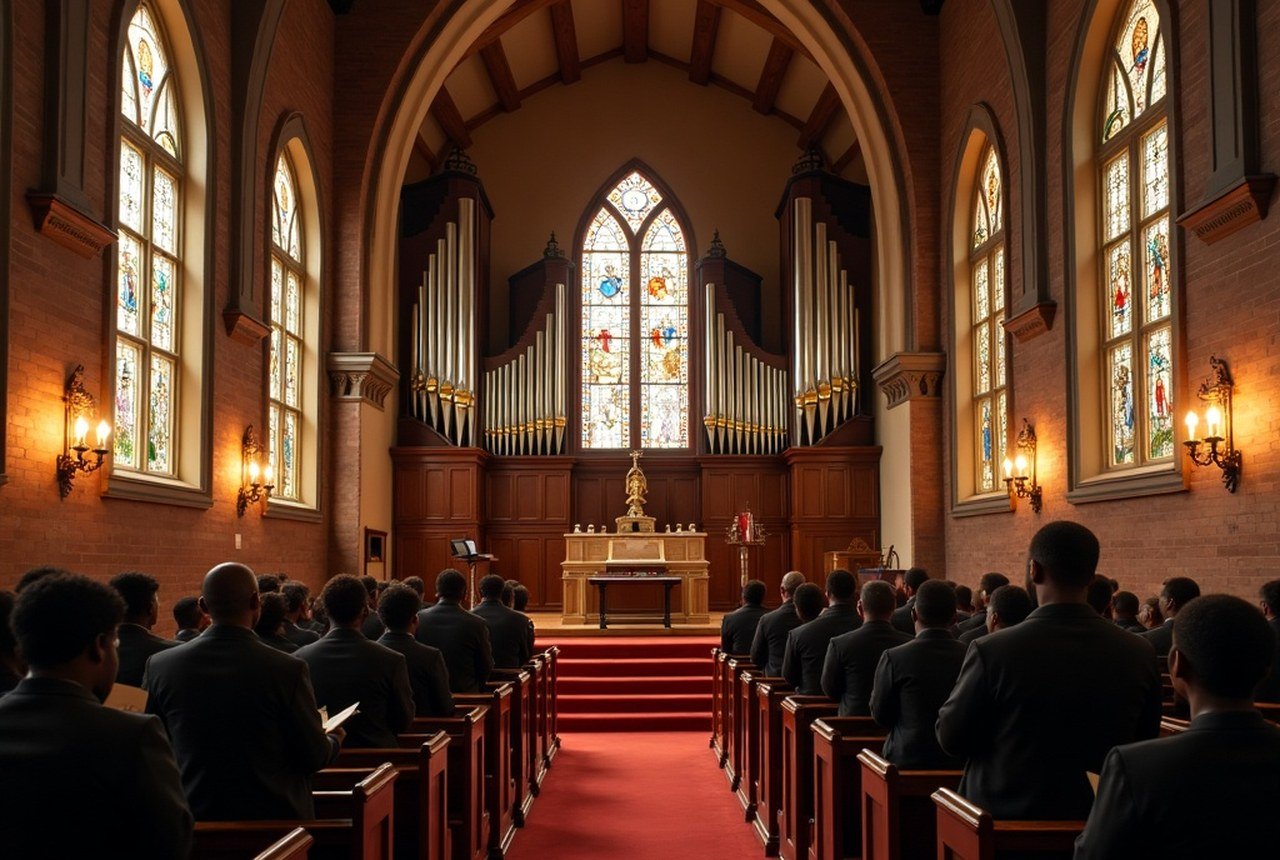
A guide for heritage travellers: how to arrive with respect, what the architecture is telling you, and why these sanctuaries are still very much alive.
ICome as a Guest, Not a Spectator
Historic Black churches are not museums. The sanctuaries that appear on heritage trails and civil-rights itineraries across America are, in almost every case, active congregations — communities that have worshipped continuously through slavery, Reconstruction, Jim Crow and beyond. That unbroken life is precisely what makes them remarkable, and it is the first thing a visitor should hold in mind.
Contact the church before you visit. Most historic congregations welcome respectful visitors, and many offer scheduled tours, but walking unannounced into a mid-week ministry session or an afternoon choir rehearsal is an intrusion. A quick call or email — explaining that you are a heritage traveller, asking whether a tour is available and whether any Sunday services are open to guests — costs nothing and signals the seriousness you bring.
Dress matters. These are consecrated spaces with dress customs that run deep. Business-casual is rarely wrong; for a Sunday visit, err on the side of formal. If you plan to attend a service rather than a tour, plan to stay for all of it. Slipping out mid-sermon is disruptive and, in communities shaped by a tradition that treats the worship hour as sacred time, it reads as dismissive.
Photography deserves its own rule: ask, always. Many congregations permit photography of the sanctuary before or after a service; some do not allow it at all during worship. Photographing worshippers without permission is never appropriate. If a church has a designated heritage docent or guide, follow their lead.
IIWhat the Building Is Saying
Learning to read the architecture of a historic Black sanctuary rewards any visit. These buildings are layered documents — of aspiration, of self-determination, and sometimes of deliberate defiance.
The oldest congregations, such as First African Baptist Church in Savannah or Mother Bethel A.M.E. in Philadelphia, occupy structures built and rebuilt over generations, each version reflecting the resources and ambitions of a community that owned almost nothing when it started. Look at the quality of the brickwork, the scale of the windows, the height of the ceiling. In a neighborhood where Black families were systematically denied wealth, a soaring nave was a statement.
The Sixteenth Street Baptist Church in Birmingham carries the Moorish Revival detailing that was fashionable in the early twentieth century — a congregation reaching confidently for architectural beauty at a moment of brutal repression. At Abyssinian Baptist Church in Harlem, the Gothic and Tudor stonework that greets visitors on 138th Street was chosen to signal permanence and dignity in a city that offered Black New Yorkers neither easily.
Inside, look for the choir loft — often prominent, sometimes the visual centerpiece of the whole sanctuary. The mass choir is not incidental to Black church worship; its placement in the architecture acknowledges that the music is as central as the sermon. Notice the pulpit: raised and commanding in most historic sanctuaries, it speaks to a tradition in which the art of preaching carried a community's whole emotional and intellectual life. Look for memorial windows, anniversary plaques, and dedication stones — small archives embedded in the walls themselves.
IIIBeing a Good Guest of a Living Heritage
If you are invited to worship rather than simply tour, enter the experience with openness. Call-and-response means the congregation is an active participant, not a silent audience; you may hear spontaneous affirmation, movement, collective sound. This is not a performance for visitors — it is the tradition functioning as it always has.
Accept any programme or bulletin offered at the door; it is both a courtesy and a guide. Tip generously if a tour is offered on a donation basis — preserving these sanctuaries costs real money, and most historic Black churches operate without the endowments that protect comparable white-majority landmarks.
Above all, remember that these buildings survived because the people inside them refused to let them fall. The heritage traveller's role is to witness that survival with the gravity it deserves — as a guest of a living community, not a tourist at a monument.