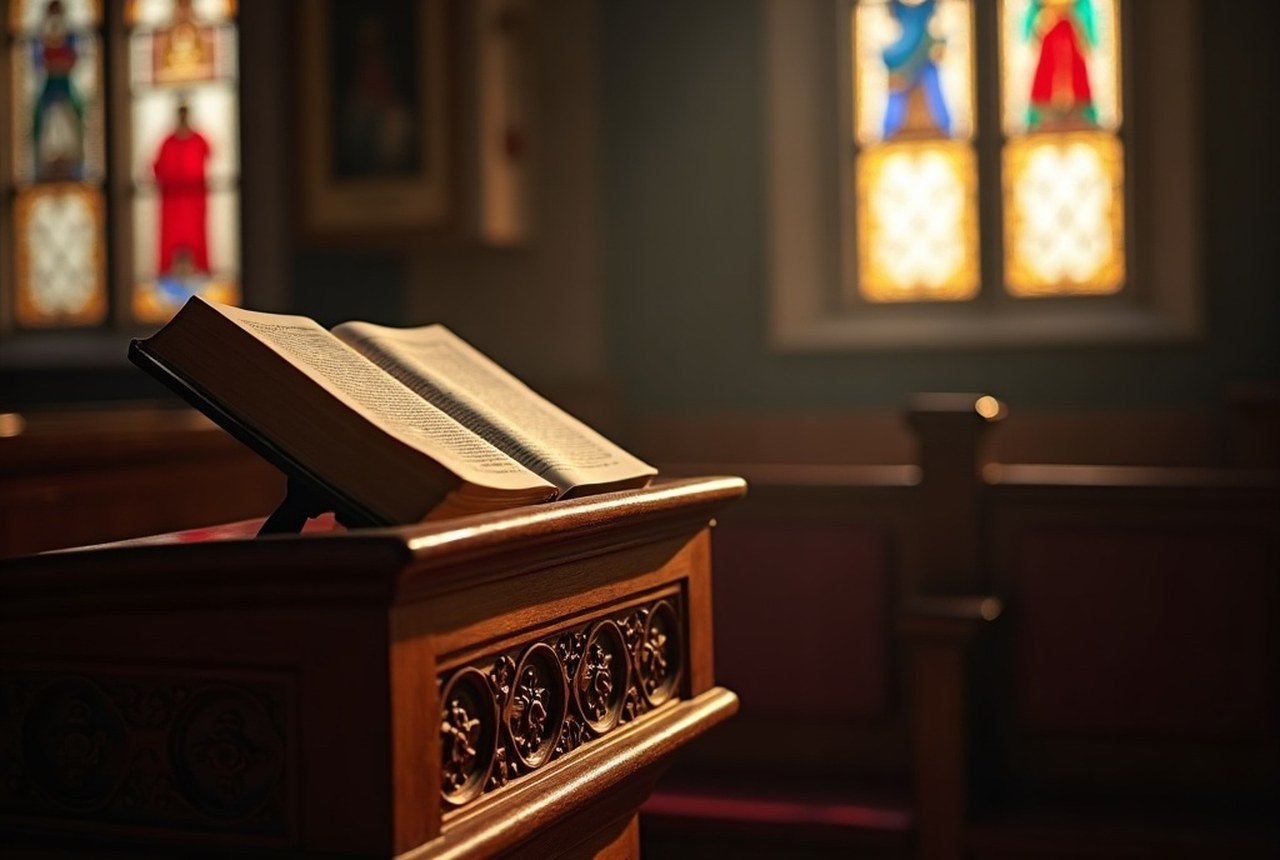
The Black pulpit has produced some of the most sophisticated oral literature in American history — a living tradition built on rhythm, breath, and the answering voice of a congregation.
IThe Sermon as Architecture
The Black sermon is not simply a talk about scripture. It is a structured performance, as carefully shaped as a sonnet and as unpredictable as jazz. Rooted in the folk sermon tradition that emerged when literacy was legally denied to enslaved people, it developed an architecture of its own: a measured opening that builds gradually, a middle section that unfolds argument and story, and a closing passage that rises, often literally, into song.
That closing passage — the chanted close — is the moment listeners recognize even if they have never heard the term. The preacher's speaking voice tips, almost imperceptibly at first, into a melodic cadence. Words begin to land on a rhythm. Breath becomes an instrument. What sounded like reasoned exposition becomes, in its final minutes, something closer to music. Scholars of American oratory have traced the form to West African griot traditions, to the ring shout, to the very conditions of the invisible church — where enslaved worshippers met in secret and the voice alone carried the entire weight of the service.
IICall-and-Response: The Congregation Finishes the Sentence
No analysis of the Black sermon is complete without its other half: the congregation. Call-and-response is not mere enthusiasm — it is a structural element. The preacher delivers a phrase; the congregation replies with Amen, Well, Say it, or Come on — not randomly, but in a practiced, near-liturgical exchange that shapes the sermon's pacing and emotional arc. The preacher reads the room the way a musician reads a rhythm section, speeding up or pulling back in response to what comes back from the pews.
This is oral composition in real time. The preacher may carry a prepared outline, but the sermon that actually unfolds on a given Sunday is a negotiation between that outline and the congregation's response. A phrase that lands hard gets repeated, extended, turned. One that falls quiet gets moved past. The result is a work that is different every time — genuinely improvised within a tradition of great discipline.
IIIThe Sermon as Poetry
Read the transcripts of great Black sermons, stripped of their delivery, and what remains is still remarkable: dense, imagistic prose built on parallelism, repetition, and the kind of rhythmic variation that poets spend careers learning to control. These are not accidents. The folk sermon developed its rhetorical tools over generations, passed from preacher to preacher in a tradition closer to oral poetry than to the written essay.
Gospel music and the sermon grew up together in this same soil, and they share a grammar — the repeated refrain, the unexpected key change, the moment of held silence before the resolution. When a mass choir closes out a service that began with a great sermon, the two art forms are completing each other's sentences.
Understanding the sermon as literature — as one of America's genuinely original contributions to world oratory — means taking seriously a tradition that broader culture has sometimes consumed without crediting. Heritage travellers who visit the historic sanctuaries, who sit in the pews and hear the tradition live, often describe the experience as the encounter they were least prepared for. The architecture could be studied from photographs. The sermon, in all its call-and-response electricity, had to be heard.