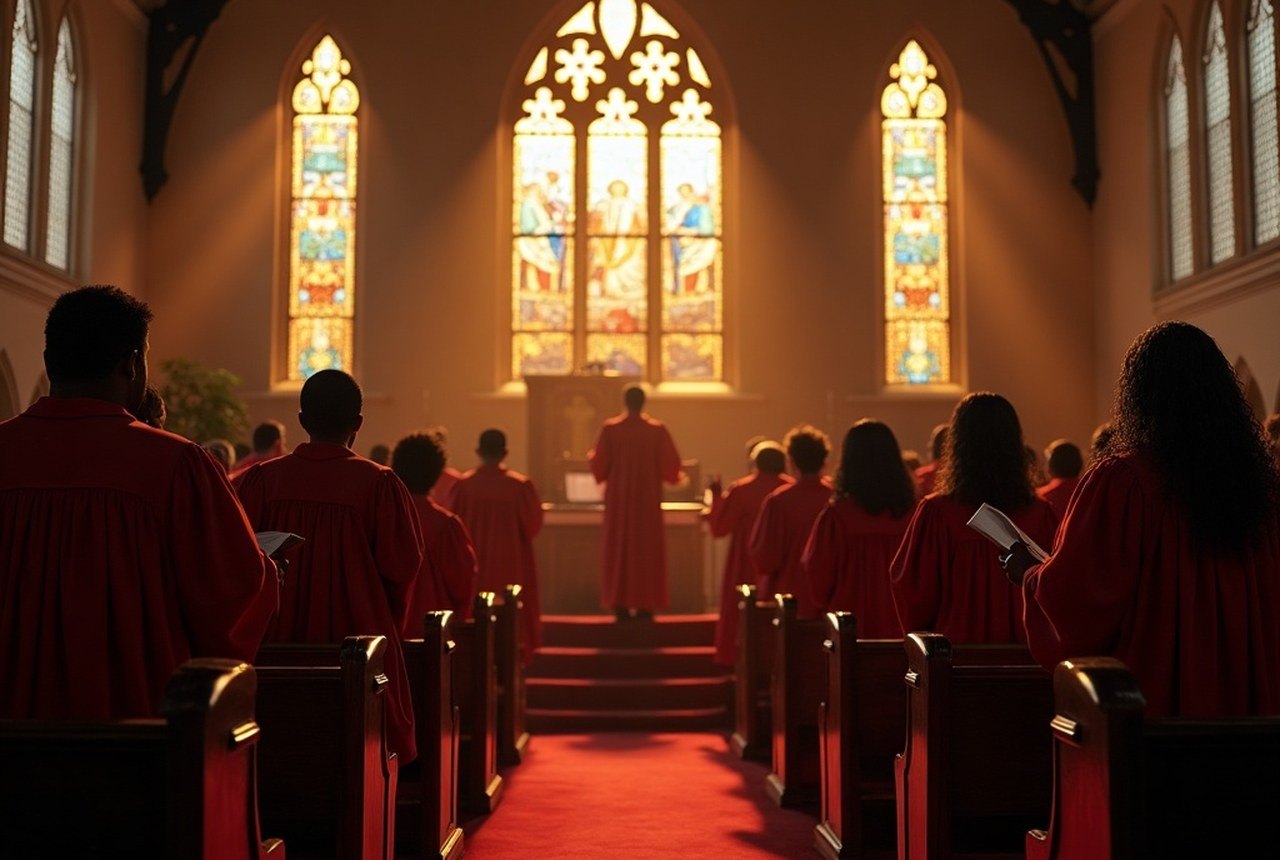
When a hundred voices move as one, the sanctuary itself seems to breathe.
IThe Sound That Fills a Room
There is nothing quite like a mass choir in full voice. Not the polished four-part harmony of a university ensemble, not the intimate praise of a small worship team — but a hundred or more robed singers arranged in tiered risers, the basses laying down a floor of sound while the sopranos arc overhead, and the whole structure swaying, almost imperceptibly, as one body. The room changes. The air thickens. Visitors who have never set foot in a Black church often describe the experience as physically overwhelming in the best possible sense.
The mass choir as a formal institution grew out of the same ferment that produced gospel music itself — the storefront churches and great migration-era congregations of Chicago, Detroit, and Philadelphia in the 1920s and 1930s. Thomas A. Dorsey, the so-called father of gospel music, understood early that a larger choir amplified not just volume but emotional authority. Robes mattered too: they signaled that this music, sometimes dismissed as too earthy for respectable worship, belonged fully inside the sanctuary.
By the postwar decades, the mass choir had become a fixture of the Black Protestant tradition. The Olivet Baptist Church on Chicago's South Side maintained one of the great early choir programs, a direct inheritance of its role as anchor congregation for the Great Migration. Anniversary Sundays — the choir's annual celebration of its founding — became events the community calendared months in advance, drawing returned members, visiting choirs, and recording artists back to the mother church.
The tradition is inseparable from the call-and-response dynamic that runs through all Black worship. A skilled choir director reads the room the way a preacher reads a congregation — pressing harder when the spirit is high, pulling back to let silence do its work, then releasing the full ensemble like a wave. The choir does not merely accompany worship; it leads it.
Today, mass choir culture thrives across AME, Baptist, and UCC congregations, and the annual choir anniversary remains one of the most important dates on the Black church calendar. Guest choirs travel significant distances to participate. Recordings circulate informally, traded with the same care as any treasured document. For heritage travellers, attending an anniversary Sunday — robes pressed, voices tuned, the room alive — is one of the most direct encounters available with a living, breathing expression of this tradition.
You will not need a program to tell you when the choir is in full flight. You will simply know.