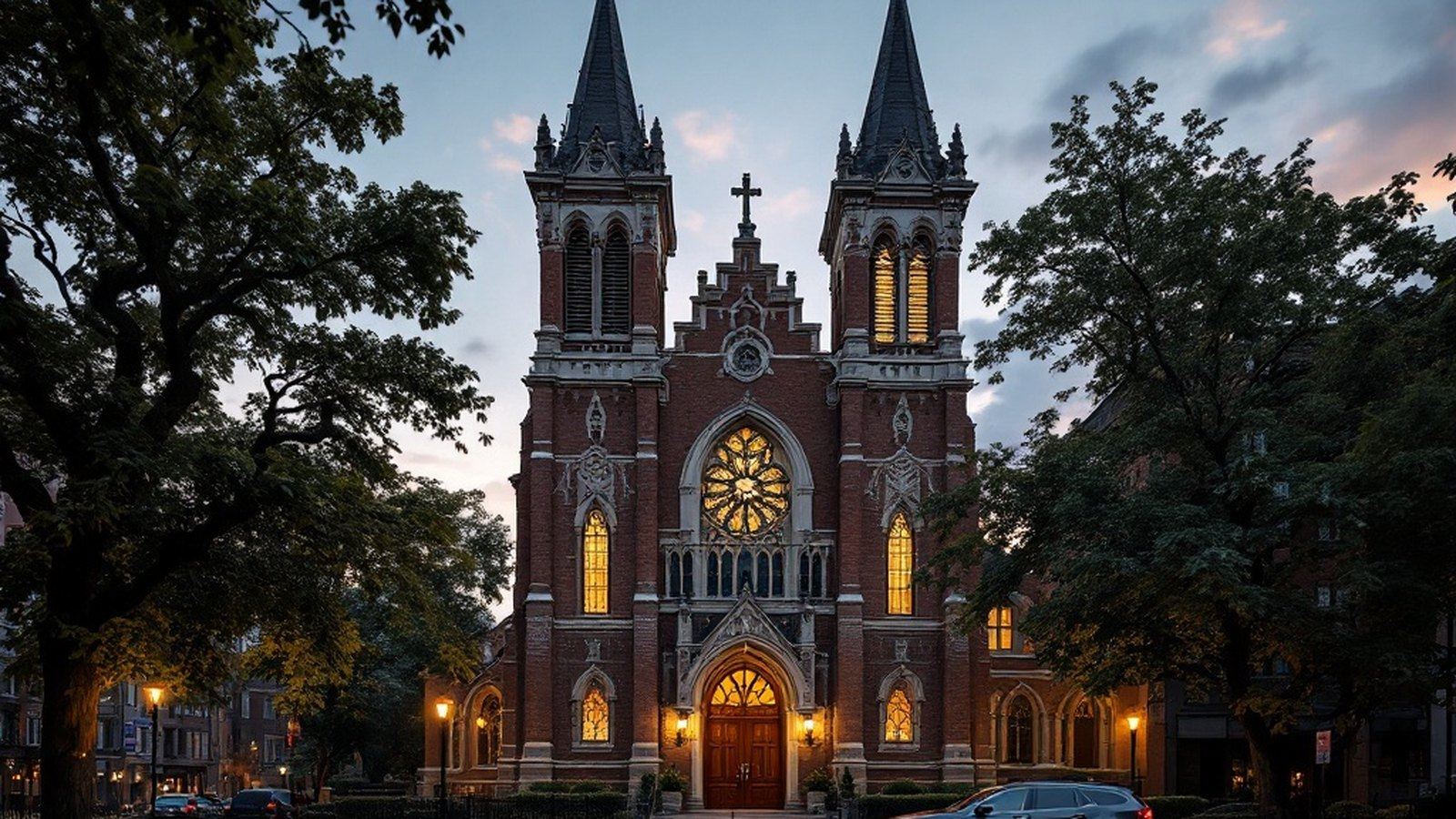
One of America's most storied congregations — a Harlem landmark where the pulpit and the public square have always shared the same address.
IA Congregation That Shaped a Borough
Abyssinian Baptist Church traces its origins to 1808, when a group of African American worshippers and Ethiopian merchants refused to accept segregated seating at a New York City Baptist congregation and walked out to form their own. That act of dignified defiance planted a church that would eventually become one of the most influential Black institutions in America.
At a glance
- Founded
- 1808
- Tradition
- Baptist
- Place
- West 138th Street, Harlem
- Sanctuary
- Gothic & Tudor Revival, since 1923
The congregation moved to Harlem in 1923, settling into its striking Gothic and Tudor revival sanctuary on West 138th Street — a building that remains, to any heritage traveller making their way through upper Manhattan, an unmistakable presence. The structure's warm Bedford stone exterior and richly appointed interior have made it one of the neighbourhood's defining architectural landmarks.
Abyssinian's national stature rose dramatically under Adam Clayton Powell Sr., who built it into a congregation of thousands during the Great Migration years, when Harlem was absorbing wave after wave of Black Southerners seeking new lives. His son, Adam Clayton Powell Jr., took the pulpit in 1937 and wielded it as a lever on the wider world — organising boycotts, fighting employment discrimination, and eventually carrying Harlem's voice to the United States Congress, where he served for more than two decades. The church stood at the precise intersection of the sanctuary and social change that has defined the Black church tradition at its most engaged.
Today the sanctuary still draws visitors alongside its active congregation. Sunday services, rooted in the full power of Black preaching and choral music, continue the tradition that has never really paused since 1808.