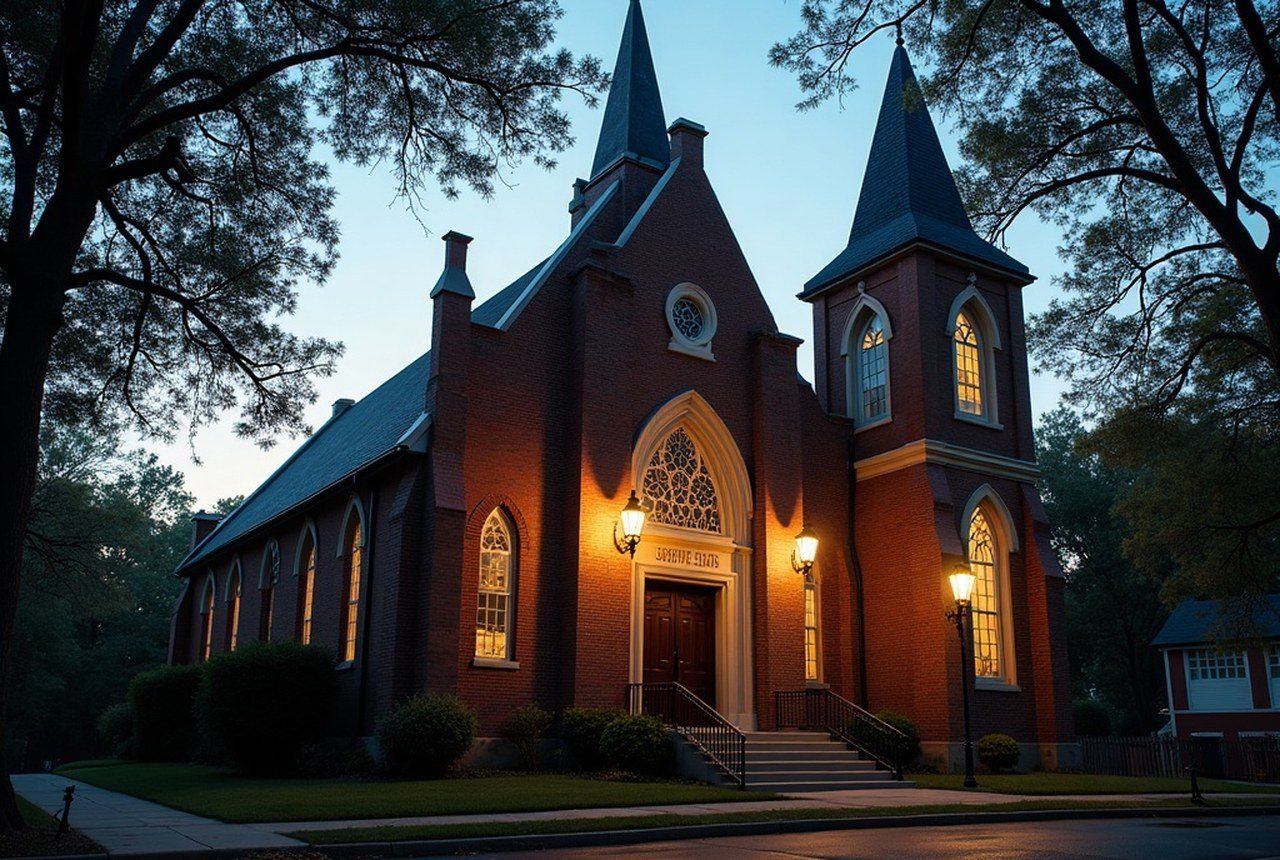
From abolition to civil rights and beyond, the Black sanctuary has never been merely a place of worship — it has been the engine room of American social change.
IThe Church as the First Organizer
Long before the phrase "community organizing" entered the political vocabulary, the Black church was doing the work. In the antebellum North, independent congregations served as nerve centers for the abolitionist cause, sheltering freedom seekers, circulating anti-slavery literature, and providing the one institutional space where a Black community could gather, deliberate, and act. Mother Bethel A.M.E. in Philadelphia harbored freedom seekers moving through the city; First African Baptist in Savannah maintained its congregation even under the crushing scrutiny of the slaveholding South. These were not incidental acts of charity. They were political — and the people who performed them knew it.
The Black church was, in the plainest sense, the first institution that African Americans fully controlled. It owned property. It trained leaders. It held money. It produced writers, orators, and organizers whose formation happened in the pew and at the pulpit before it happened anywhere else. When Frederick Douglass described the corruption of religious hypocrisy in slaveholding America, he was also, by contrast, describing the counter-tradition — a church that practiced the theology it preached. That counter-tradition ran like a spine through the next two centuries of American history.
IIThe Sanctuary in the Civil-Rights Era
The mid-twentieth century brought the church's organizing role into the full light of American public life. The Montgomery Bus Boycott of 1955–56 was sustained in large part through the network of Black Baptist churches that coordinated carpools, collected funds, and kept thousands of participants unified across more than a year of economic sacrifice. The mass meeting — held in a church, opened with a hymn, structured by the call-and-response rhythms of the folk sermon — became the strategic session and the morale rally in one. The sanctuary provided not just space but a shared language, a shared emotional grammar that no hotel ballroom could replicate.
Sixteenth Street Baptist Church in Birmingham became, after the bombing of September 1963, the most shattering symbol of what the movement faced — and what it refused to yield to. Four girls killed in their Sunday-school classroom; the building itself turned into evidence. That the congregation continued to meet, that the building was preserved and became a National Historic Landmark, is itself a statement about the relationship between faith and persistence.
Abyssinian Baptist Church in Harlem illustrates a different dimension of the same tradition — the long pastorate as a platform for civic power, the pulpit extended into City Hall, into Congress, into every arena where the community's interests needed a voice. Abyssinian's story runs parallel to Harlem's story: each shapes the other across decades.
What made the church uniquely effective in this era was not merely its institutional footprint but the formation it provided. The preacher trained in the art of the Black sermon — in the disciplines of call-and-response, of building an argument toward an emotionally irresistible close — was already, by training, a public persuader of the first order. The same gifts deployed on Sunday morning could move a mass meeting on a Tuesday night. The same congregation that sang together, grieved together, and celebrated together year after year was already, in social-movement terms, a dense network of trust.
IIIFrom Movement to Institution, and Back
After the legislative victories of the mid-1960s, the question became: what now? The Black church did not withdraw from civic life. It shifted terrain. Congregations built housing developments and credit unions, operated Head Start programs and after-school academies, staffed health clinics and food pantries. Olivet Baptist on Chicago's South Side exemplifies how a Great Migration-era congregation remade itself repeatedly across the twentieth century to meet the changing needs of its neighborhood. Restoring the village — the ethic of communal uplift — was never simply a metaphor; it was a capital campaign, a zoning fight, a tutoring schedule.
This civic infrastructure did not spring from nowhere. It emerged from the same ecclesiology that had always insisted the church existed for the community, not merely for the saved. The congregation that educated its children in Freedom Schools in 1964 was theologically continuous with the one that ran a Sunday school for illiterate adults in 1864. The church as institution — school, bank, meeting hall — is the same institution across those hundred years. Only the crisis changes.
Today that work continues in congregations across the country, many of them housed in buildings that are themselves documents of the struggle — worn wood, memorial windows, cornerstone dates that carry whole histories in four digits. For the heritage traveller, understanding these buildings means understanding that the sanctuary and the social-change movement were never separate things. The freedom movement did not use the church as a convenient venue. It grew from the church, in the same soil, by the same roots.